



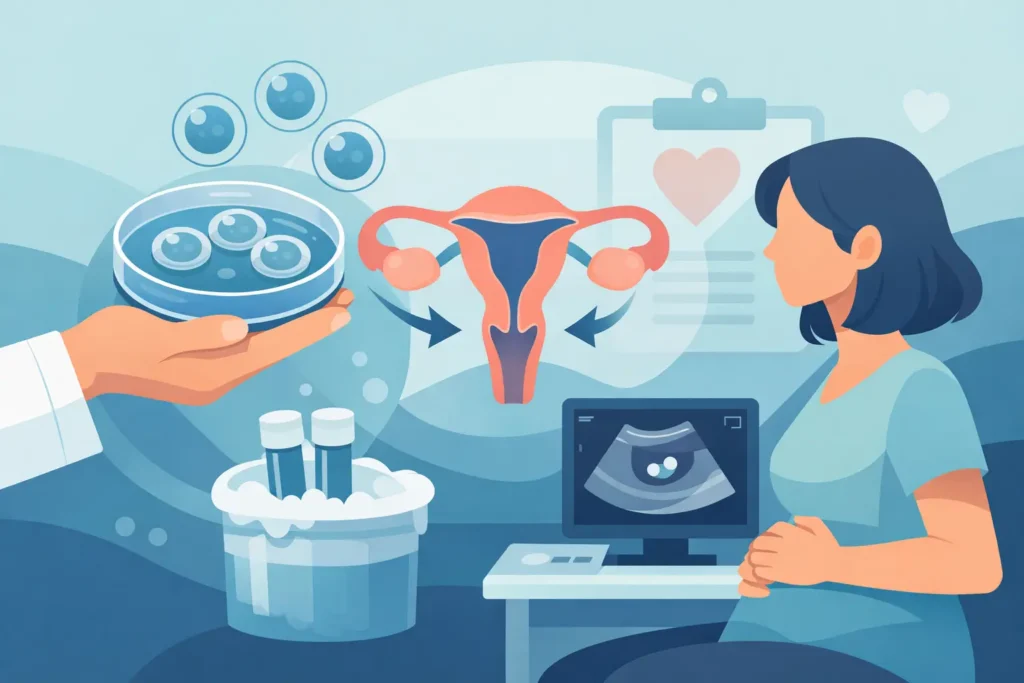
A positive pregnancy test is the hope behind every IVF cycle, which can make the question of how many embryos to transfer feel especially weighty. It may seem that transferring more embryos should improve the chance of success. But in modern fertility care, the goal is not simply pregnancy. It is the safest possible path to one healthy baby and a healthy parent.
For many patients, transferring one embryo offers an excellent chance of pregnancy while greatly lowering the risks associated with twins or higher-order multiple pregnancies. The right decision is personal and clinical, shaped by your embryo, treatment history, health, and family-building goals.
How many embryos to transfer in IVF?
In many IVF cycles, specialists recommend elective single embryo transfer, often called eSET. This means transferring one embryo that has been selected as the most likely to implant.
This approach is particularly common when a good-quality blastocyst is available, especially for younger patients or when the embryo has been tested with preimplantation genetic testing for aneuploidy, known as PGT-A. A euploid embryo has the expected number of chromosomes, which may improve the likelihood of implantation and reduce the risk of miscarriage related to chromosomal abnormalities.
A single embryo transfer is not a lesser attempt. It is a carefully considered strategy that aims to preserve your chance of success while reducing preventable risks. If the transfer does not lead to pregnancy, another frozen embryo may be available for a later attempt without needing to repeat ovarian stimulation and egg retrieval.
There are circumstances in which transferring two embryos may be discussed. For example, this may be considered for selected patients with repeated unsuccessful transfers, older age, or embryos with a lower predicted chance of implantation. Even then, the decision should be made cautiously and after a detailed discussion with a fertility specialist.
Why transferring more embryos is not always better
Each embryo has its own chance of implanting. When two embryos are transferred, both may implant, resulting in twins. While twin pregnancy can be joyful, it also carries significantly higher medical risks for both the pregnant person and babies.
Compared with singleton pregnancies, twin pregnancies are more likely to involve premature birth, low birth weight, gestational diabetes, high blood pressure disorders such as preeclampsia, placental complications, cesarean delivery, and admission to a neonatal intensive care unit. Premature babies may also face longer-term developmental or health challenges.
The risks rise further with triplets or more, which is why transferring three or more embryos is rarely appropriate in current IVF practice. The aim is not to remove all uncertainty from treatment – no clinic can promise that – but to avoid increasing risk when safer options are available.
For patients who have waited a long time to conceive, it is understandable to feel that twins would be a welcome outcome. A compassionate consultation should make space for that feeling while also explaining what a multiple pregnancy can demand physically, emotionally, and financially. A healthy singleton pregnancy is generally the preferred outcome in fertility medicine.
The factors your fertility specialist will consider
Embryo transfer planning should never rely on age alone or a fixed rule. Your care team will look at the complete clinical picture.
Embryo stage and quality
Embryos may be transferred at different developmental stages, though blastocyst transfer on day 5, 6, or sometimes day 7 is common in many IVF programs. A blastocyst has developed further in the laboratory, allowing embryologists to assess its development and appearance before transfer.
Embryo grading can provide useful information, but it cannot guarantee whether an embryo will implant. A beautifully graded embryo may not lead to pregnancy, while an embryo with a more modest grade may become a healthy baby. Grading is one part of the decision, not the whole story.
Genetic testing results
If PGT-A has been performed, the number of embryos transferred is usually lower because a euploid embryo may have a stronger likelihood of implantation than an untested embryo. In many cases, one euploid embryo is the recommended choice.
Other forms of PGT may be used when there is a known inherited genetic condition or chromosome rearrangement. Your fertility specialist and genetic team can explain what the results mean for embryo selection. PGT is a valuable tool, but it does not replace prenatal screening or diagnostic testing during pregnancy.
Age and ovarian reserve
Age can influence egg quality and the proportion of embryos likely to have chromosomal differences. However, age is not the only measure that matters. Some patients in their late 30s or early 40s may have a strong blastocyst available and remain good candidates for single embryo transfer. Others may have had several transfers without implantation and need a more individualized discussion.
Ovarian reserve testing helps estimate how the ovaries may respond to stimulation. It does not, by itself, determine how many embryos should be transferred. Your embryo development, previous treatment outcomes, and overall health matter just as much.
Previous IVF and transfer history
A failed transfer can be deeply disappointing, but it does not automatically mean that two embryos should be transferred next time. Your specialist may first review whether there were factors related to embryo development, the uterine cavity, endometrial preparation, transfer technique, sperm factors, or embryo genetics.
Sometimes a change in the treatment plan is more meaningful than increasing the number of embryos. This may include further assessment, a different frozen embryo transfer protocol, or considering PGT where appropriate. The most helpful next step depends on the reasons a prior cycle may not have worked.
Your health and pregnancy risks
Existing medical conditions, uterine health, body weight, blood pressure, and prior pregnancy history can all affect the safety of carrying twins. For some patients, avoiding a multiple pregnancy is particularly important because it could create a substantial health risk.
This is also why fertility care should be coordinated with obstetric care when needed. The embryo transfer decision is not only about achieving implantation. It is about supporting a pregnancy that is as safe as possible from the earliest stage.
Fresh versus frozen embryo transfer
The number of embryos transferred may be considered in both fresh and frozen embryo transfer cycles. In a fresh transfer, an embryo is placed in the uterus a few days after egg retrieval. In a frozen embryo transfer, an embryo created in a previous IVF cycle is thawed and transferred after the uterine lining is prepared.
Frozen embryo transfer can give your team time to assess embryo development, complete PGT if chosen, and plan transfer timing around your body and treatment needs. It can also allow embryos to be transferred one at a time across separate cycles. This approach may offer a cumulative chance of building a family while limiting the risks of multiple pregnancy.
Not every patient needs a freeze-all approach, and not every fresh transfer is unsuitable. The best plan depends on hormone levels, risk of ovarian hyperstimulation syndrome, embryo availability, genetic testing plans, and your individual circumstances.
Questions to bring to your consultation
Before consenting to embryo transfer, ask your specialist what they recommend and why. It can help to discuss the expected chance of live birth with one embryo compared with two, your specific risk of twins, and whether another embryo can be frozen for future use.
You may also want to ask how embryo quality was assessed, whether PGT is relevant to your circumstances, and what your previous cycle results suggest. If you feel torn between maximizing one-cycle odds and minimizing pregnancy risks, say so openly. There is no need to carry that decision alone.
At IVcare Fertility, treatment planning is built around your medical needs, your values, and your hopes for the future. A recommendation for one embryo is often a recommendation for a safer beginning, not a smaller chance at the family you want.
The right transfer plan should leave you feeling informed rather than pressured. One carefully selected embryo can carry extraordinary potential, and choosing the safest path can be one of the most powerful ways to protect the new beginning you are working toward.