



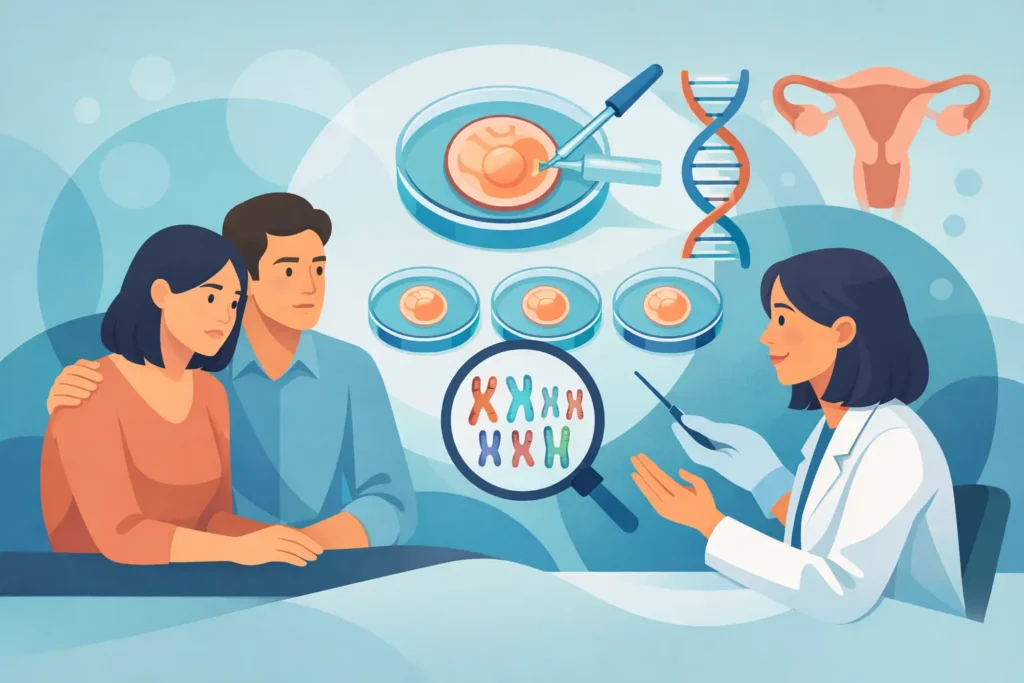
A positive pregnancy test can feel like the long-awaited beginning of a new chapter. For some families, however, the path to that moment includes difficult questions about inherited conditions, repeated miscarriage, or embryos that have not implanted. This is where people often ask: who needs PGT testing IVF treatment? The answer is not everyone. Preimplantation genetic testing, or PGT, can be valuable in specific circumstances, but it should be recommended based on your medical history, genetic risk, age, fertility diagnosis, and personal goals.
PGT is an additional laboratory step used alongside IVF. It may help identify embryos with certain genetic findings before an embryo transfer, allowing your fertility specialist to develop a more informed plan. It is a powerful option, but not a guarantee of pregnancy or a replacement for prenatal testing.
What PGT testing with IVF involves
IVF involves stimulating the ovaries to collect eggs, fertilizing them in the laboratory, and growing resulting embryos for several days. If PGT is part of the plan, a small number of cells are carefully biopsied from an embryo at the blastocyst stage, usually on day 5, 6, or 7. The embryo is then frozen while the cells are analyzed in a specialized genetics laboratory.
When results are available, your specialist can discuss which embryos may be appropriate to consider for transfer. The purpose is not to create a “perfect” baby. Rather, PGT can provide information about particular chromosome or gene-related concerns that may affect implantation, miscarriage risk, or the chance of passing on a known inherited condition.
There are different forms of PGT, and they answer different questions. PGT-A screens for embryos with an abnormal number of chromosomes. PGT-M is used when one or both intended parents carry a known single-gene condition, such as thalassemia or cystic fibrosis. PGT-SR may be considered when a parent has a structural chromosome rearrangement, such as a translocation.
Who needs PGT testing IVF most often?
PGT is not routinely necessary for every person having IVF. It may be particularly worth discussing with a fertility specialist in several situations.
Couples with a known genetic condition or carrier status
PGT-M can be considered when there is a known risk of passing on a specific inherited condition. This may apply when one or both partners have genetic test results showing they carry a disease-causing variant, when a child or close family member has a hereditary condition, or when previous pregnancies have been affected.
The process requires careful preparation. Before an IVF cycle begins, the genetics laboratory may need to develop a personalized test that can identify the family’s specific genetic variant. Genetic counseling is especially helpful here, as it allows you to understand what the test can detect, which embryos may be suitable for transfer, and what results could mean for your family.
People with a chromosome rearrangement
Some people carry a balanced translocation or another structural chromosome rearrangement. They may be healthy themselves but have a higher likelihood of producing eggs or sperm with an unbalanced chromosome arrangement. This can contribute to recurrent miscarriage, unsuccessful pregnancies, or the birth of a child with a chromosome condition.
PGT-SR may help identify embryos that do not show the unbalanced rearrangement being tested for. For couples who have faced repeated loss, having this information before transfer can bring clarity to an otherwise painful and uncertain process.
Women of advanced reproductive age
As egg age increases, embryos are more likely to have chromosome-number differences, also called aneuploidy. These differences are a common reason embryos do not implant or pregnancies end in miscarriage. PGT-A may be considered for women in their late 30s or early 40s, particularly when IVF produces several embryos available for testing.
Still, age alone does not automatically mean PGT-A is the right choice. If only one or two embryos are expected, testing may not improve the overall chance of having a baby from that IVF cycle. Your doctor will consider ovarian reserve, expected egg yield, embryo development, previous outcomes, and how you feel about embryo selection and additional cost.
Those who have experienced recurrent miscarriage
Miscarriage is deeply personal, and it is never simply something to “move past.” When two or more losses have occurred, a detailed evaluation may include uterine assessment, hormone testing, screening for medical factors, semen analysis, and, in some cases, chromosome testing for both partners.
Because chromosome abnormalities are a frequent cause of early miscarriage, PGT-A or PGT-SR may be discussed depending on the findings. It may help reduce the chance of transferring an embryo with certain chromosome abnormalities, but it cannot address every cause of miscarriage. A thoughtful plan should look beyond embryo genetics alone.
Couples with repeated IVF implantation failure
When good-quality embryos have been transferred without a pregnancy, it is natural to seek clearer answers. PGT-A may be one part of the conversation, especially if embryos have not previously been tested. However, implantation is influenced by more than embryo chromosomes. The uterus, timing of transfer, hormone preparation, embryo quality, sperm factors, and underlying health conditions can all matter.
For this reason, repeated unsuccessful transfers deserve a full review rather than a one-size-fits-all recommendation for PGT. The right next step may be genetic testing, but it may also be a change in stimulation protocol, further uterine evaluation, or a different transfer strategy.
When PGT may not be the best next step
PGT adds cost, laboratory coordination, and time to an IVF cycle. It also requires embryos to reach the blastocyst stage and usually involves freezing before transfer. Although embryo biopsy is performed with great care, no medical procedure is entirely without limitations.
A result can be inconclusive, and not every embryo will be suitable for testing or transfer. Some embryos may show mosaic results, meaning the sampled cells have a mixture of chromosome patterns. These findings require nuanced counseling because a biopsy samples cells that are expected to form the placenta, not the baby itself. In selected cases, a mosaic embryo may still be considered for transfer after detailed discussion with your care team and a genetic counselor.
For younger patients with no known genetic concerns and a limited number of embryos, PGT-A may not increase the cumulative chance of a live birth from one egg retrieval. It can sometimes help prioritize which embryo to transfer first, but that is different from increasing the total number of healthy embryos created. This distinction matters when making a decision that feels both medical and emotional.
Important limits to understand before testing
PGT is a screening or targeted testing tool, depending on the type used. It does not test for every possible genetic condition, birth difference, developmental concern, or future health issue. A normal PGT result cannot promise a healthy pregnancy or live birth, and an abnormal result should always be interpreted in the context of the specific test and laboratory report.
For these reasons, prenatal screening and diagnostic testing may still be offered during pregnancy. Options can include noninvasive prenatal screening, chorionic villus sampling, or amniocentesis. Your obstetric and fertility teams can help you understand which follow-up is appropriate after a PGT pregnancy.
Making a decision that fits your family
The best question is not simply whether PGT is available. It is whether it meaningfully supports your particular path to parenthood. A specialist consultation should cover your fertility history, age, egg and sperm factors, prior pregnancies, family history, genetic reports, expected embryo numbers, timeline, and budget.
At IVcare Fertility, this conversation is approached as a shared decision, with clinical guidance and space for the concerns that do not fit neatly into a test result. Some patients value the additional information PGT may provide before embryo transfer. Others decide that the added steps do not align with their circumstances. Both decisions can be thoughtful and valid.
If genetic risk, pregnancy loss, or unsuccessful IVF has made your next step feel uncertain, a personalized review can turn a broad question into a plan grounded in evidence, care, and hope for the family you are building.