



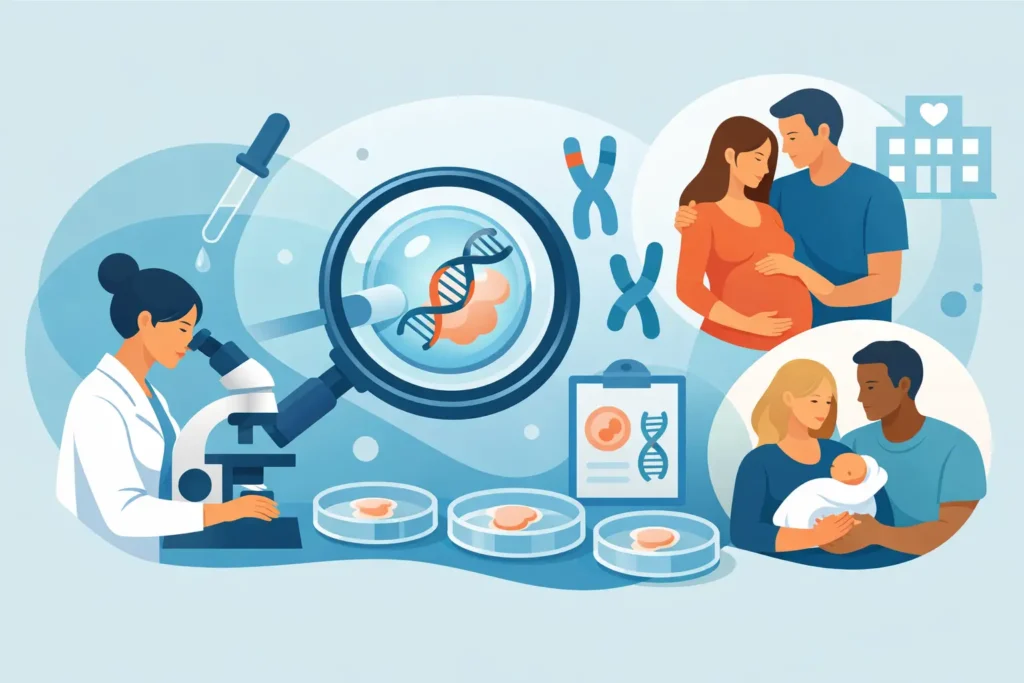
When a genetic condition has affected your family, trying to conceive can carry questions far beyond a positive pregnancy test. PGT testing for genetic conditions offers a way to examine embryos created through IVF before a pregnancy begins, helping some prospective parents make informed decisions with clearer clinical guidance and renewed hope.
This is not about creating a “perfect” baby or removing every uncertainty from pregnancy. It is a specialized option for people with a known or suspected inherited risk who want to reduce the chance of passing on a specific condition. Whether it is right for you depends on the condition, the family’s genetic results, embryo availability, and your own values.
What Is PGT Testing for Genetic Conditions?
Preimplantation genetic testing, or PGT, is performed alongside in vitro fertilization (IVF). Eggs are collected, fertilized in the laboratory, and allowed to develop into embryos. At the blastocyst stage, usually around day 5 or day 6 of development, a small number of cells are carefully biopsied from the part of the embryo that is expected to form the placenta.
Those cells are sent to a genetics laboratory for analysis. The embryo is then frozen while results are prepared. If testing identifies embryos that are unlikely to be affected by the condition being tested for, your fertility specialist can discuss whether an embryo transfer may be appropriate.
For a known single-gene condition, the relevant test is usually called PGT-M, with the M referring to monogenic, or single-gene, disorders. PGT-M is designed around a particular genetic variant found in an individual or family. This makes it very different from a broad health screening test.
Another form, PGT-SR, may be considered when one prospective parent carries a structural chromosome rearrangement, such as a balanced translocation. A person with a balanced rearrangement may be healthy themselves but may have a higher likelihood of producing embryos with an unbalanced chromosome arrangement. This can contribute to infertility, recurrent miscarriage, or a pregnancy affected by a chromosome condition.
Who May Benefit From PGT Testing for Genetic Conditions?
PGT may be worth discussing if you or your partner have a confirmed genetic diagnosis, are known carriers of the same recessive condition, or have a family history that suggests an inherited disorder. It may also be considered after a child or pregnancy has been affected by a genetic condition, even when parents have no symptoms themselves.
Examples include autosomal recessive conditions such as thalassemia, spinal muscular atrophy, and cystic fibrosis; autosomal dominant conditions such as Huntington disease; and certain X-linked conditions. The right approach differs greatly between families. For example, a couple who both carry a recessive condition may face a different reproductive risk than someone with a dominant condition who has a 50% chance of passing on a genetic variant with each pregnancy.
Before PGT is recommended, genetic counseling and detailed genetic testing are essential. Your care team needs to know exactly what variant or chromosome change is being investigated. In some cases, testing samples from relatives may also help the laboratory build the most accurate test for your family.
Why IVF Is Part of the Process
PGT cannot be performed during natural conception. IVF is required because embryos must be created and developed in the laboratory before a small biopsy can be taken.
The process usually begins with ovarian stimulation, where fertility medication encourages several eggs to mature. After egg retrieval, the eggs are fertilized, often using intracytoplasmic sperm injection, or ICSI, in which a single sperm is injected into each mature egg. ICSI is commonly used in PGT cycles to reduce the possibility that genetic testing is affected by DNA from sperm cells attached to the outside of an embryo.
Not every egg will fertilize, and not every fertilized egg will become a blastocyst suitable for biopsy. This can be emotionally difficult, particularly when the purpose of treatment is to avoid a known genetic condition. A specialist-led plan should prepare you for these possibilities from the beginning, including how age, ovarian reserve, sperm factors, and the inheritance pattern may influence the number of embryos available.
The Test Must Be Prepared for Your Family
One practical consideration is timing. PGT-M often requires a laboratory preparation phase before an IVF cycle starts. The lab develops and validates a test that can distinguish between embryos that have inherited, have not inherited, or may have an unclear result for the family’s known genetic variant.
This preparation can take several weeks or longer. Starting with a preconception consultation gives you time to gather medical records, arrange carrier screening or diagnostic testing if needed, and understand the expected timeline before treatment begins.
What PGT Can and Cannot Tell You
PGT is a powerful reproductive tool, but it has clear boundaries. PGT-M looks for the specific genetic condition or variant that the test was designed to detect. It does not rule out all genetic conditions, developmental differences, birth defects, or future health concerns.
Similarly, PGT-SR focuses on the known chromosome rearrangement. It does not necessarily provide the same information as PGT-A, a separate test that screens for chromosome number differences. Some patients may be offered more than one form of PGT, but this decision should be individualized rather than assumed. Combining tests may provide additional information in some circumstances, yet it can also add cost, complexity, and the possibility that fewer embryos are considered suitable for transfer.
A result may occasionally be inconclusive. Embryos can also be affected by mosaicism, where sampled cells do not fully reflect every cell in the embryo. Your fertility specialist and genetic counselor can explain what a particular result means and whether additional discussion or testing is appropriate.
Most importantly, PGT reduces risk; it does not provide an absolute guarantee. Professional guidance commonly recommends discussing prenatal testing options after pregnancy is established. Screening tests and diagnostic procedures such as chorionic villus sampling or amniocentesis serve different purposes, and your obstetric and genetics teams can help you decide what level of confirmation feels right for you.
The Decisions Are Medical and Personal
For some families, PGT brings relief after years of uncertainty, loss, or difficult reproductive decisions. For others, the physical demands of IVF, financial considerations, religious or ethical beliefs, or the prospect of having few unaffected embryos may make another path feel more appropriate.
There is no single “right” response to genetic risk. Some people choose IVF with PGT; others consider natural conception with prenatal diagnosis, donor eggs or sperm, adoption, or remaining child-free. Compassionate care means having space to understand each option without pressure.
It is also reasonable to ask direct questions before proceeding: What condition is this test designed to identify? How reliable is the test for our family’s variant? How long will preparation and results take? What happens if no embryos are suitable for transfer? What prenatal testing might still be advised? Clear answers can make a complex process feel more manageable.
Planning Care With the Right Support
A PGT journey brings together fertility medicine, embryology, genetics, and emotional support. At IVcare Fertility in Petaling Jaya, this coordinated approach helps ensure that treatment planning considers not only laboratory results, but also your medical history, future family goals, and the realities of each treatment cycle.
If a genetic condition is part of your family-planning story, a consultation can be a meaningful first step. Bring any prior genetic reports, records from affected relatives where available, and the questions you have been carrying. With careful assessment and supportive guidance, you can consider your next step with knowledge, choice, and hope.