



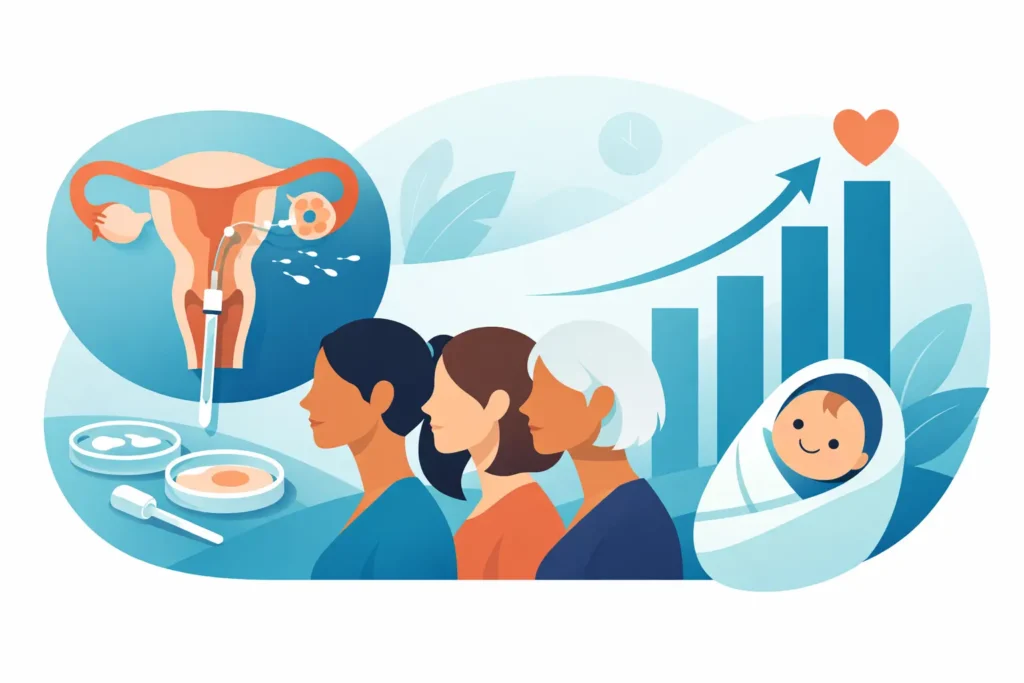
For many people, the hardest part of considering IUI is not the procedure itself. It is hearing a percentage and wondering what it means for your chance of bringing home a baby. IUI success rates by age offer a useful starting point, but they cannot tell the whole story. Egg quality, sperm health, ovulation, fallopian tube function, medication, and the reason pregnancy has not happened all matter.
Intrauterine insemination, or IUI, is a treatment in which specially prepared sperm is placed directly into the uterus around the time of ovulation. It is less invasive and generally less costly than IVF, which can make it an appropriate first treatment for some patients. A fertility specialist can help put age-related numbers into context and recommend a plan that protects both your hope and your time.
IUI success rates by age: Typical expectations
Success rates are usually reported per treatment cycle, meaning one attempt of IUI. A cycle may be performed in a natural ovulation cycle or with medicines that encourage one or more eggs to develop. Published outcomes vary across clinics and patient groups, but these broad ranges can help set realistic expectations:
- Under age 35: approximately 10% to 20% per cycle
- Ages 35 to 37: approximately 10% to 15% per cycle
- Ages 38 to 40: approximately 5% to 10% per cycle
- Over age 40: often less than 5% per cycle
These figures are not guarantees, and a higher percentage is not always better if it reflects treatment that increases the risk of twins or higher-order multiple pregnancy. The most meaningful outcome is a healthy pregnancy, approached as safely as possible.
Age has such a visible effect because the number and quality of eggs gradually decline over time. This decline becomes more pronounced in the late 30s and early 40s. As egg quality changes, the chance that an egg will be fertilized and develop into a chromosomally healthy embryo also decreases. IUI can help sperm reach the egg at the right time, but it cannot change egg quality or bypass blocked fallopian tubes.
Why age is only one part of the picture
Two people of the same age can have very different fertility profiles. For that reason, age should guide the conversation, not replace a careful assessment.
Ovulation and ovarian reserve
IUI depends on ovulation. If ovulation is irregular, as may occur with polycystic ovary syndrome, medication can help time or induce ovulation. Blood tests and ultrasound may also give your specialist information about ovarian reserve, which describes the remaining egg supply. Ovarian reserve tests do not directly measure egg quality, but they can help determine how likely the ovaries are to respond to fertility medication.
Sperm quality after preparation
During IUI, the laboratory prepares the semen sample to concentrate the most motile sperm. The total number of moving sperm available after this process can influence success. IUI may be considered for mild male-factor infertility, but severe concerns with sperm count, movement, or shape may make IVF with intracytoplasmic sperm injection, or ICSI, a more effective option.
Open fallopian tubes
At least one fallopian tube generally needs to be open for IUI to work, because fertilization still takes place in the fallopian tube. A tubal patency test may be recommended before treatment, especially if there is a history of pelvic infection, endometriosis, previous pelvic surgery, or ectopic pregnancy. If both tubes are blocked, IUI is unlikely to help and IVF is usually discussed instead.
The cause and duration of infertility
IUI can be a reasonable option for unexplained infertility, ovulation problems, mild sperm concerns, or certain cases using donor sperm. Its role may be more limited with moderate to severe endometriosis, significant tubal disease, very low ovarian reserve, or a long history of unsuccessful treatment. How long you have been trying also matters. For someone in their early 30s with a recent diagnosis and favorable test results, several IUI cycles may be sensible. For someone nearing 40, a faster path to IVF may offer a better use of time.
How many IUI cycles should you try?
There is no universal number, but many pregnancies achieved through IUI occur within the first three to four well-timed cycles. If pregnancy has not occurred after several attempts, it is wise to pause and review the plan rather than continuing automatically.
That review should consider whether ovulation occurred as expected, how the ovaries responded to medication, the number of mature follicles, the post-wash sperm count, and whether any new information has emerged. It should also make room for personal factors: emotional energy, budget, work schedules, and how you feel about the chance of multiple pregnancy with stimulated cycles.
For patients age 38 and older, specialists may recommend fewer IUI attempts before discussing IVF. This is not because IUI is never possible at this age. It is because each month carries greater weight, and IVF may provide more information about fertilization and embryo development while offering higher success rates per retrieval for some patients.
IUI with medication versus a natural cycle
A natural-cycle IUI follows your body’s own ovulation. It may be appropriate when ovulation is regular and the main concern is timing, cervical factors, or mild sperm-related issues. Medication-assisted IUI may involve oral medications or injectable gonadotropins to support follicle development and ovulation.
Medication can improve the chance of releasing an egg in people who do not ovulate regularly, and it may increase the chance of pregnancy in selected cases. The trade-off is a greater possibility of developing more than one mature follicle, which raises the chance of twins or, less commonly, higher-order multiples. Careful ultrasound monitoring allows the clinical team to adjust treatment or advise against proceeding when too many follicles develop.
The right approach is not necessarily the most intensive one. It is the one that matches your diagnosis, age, response to medication, and priorities for a safe pregnancy.
When IVF may be a better next step
IVF is often discussed when IUI is unlikely to address the main barrier to conception. This can include blocked tubes, severe male-factor infertility, low success after several IUI cycles, advanced maternal age, or a need for genetic testing of embryos. IVF allows eggs to be collected, fertilized in the laboratory, and monitored as embryos develop before transfer to the uterus.
For some patients, IVF with PGT may be considered when there is a known inherited genetic condition, recurrent pregnancy loss, or specific chromosomal concerns. It is not necessary for every IVF patient, and it does not guarantee pregnancy. A specialist should explain what it can and cannot add in your individual circumstances.
Moving from IUI to IVF can feel like a major emotional and financial decision. A thoughtful consultation should give you clear reasons for the recommendation, alternatives worth considering, expected timelines, and space to ask questions without pressure.
Questions worth bringing to your consultation
Before beginning IUI, ask how your age, diagnosis, test results, and treatment history affect the clinic’s recommendation. You may also want to ask about the expected success rate per cycle in patients with a similar profile, how many cycles are reasonable before reassessment, whether medication is advised, and how multiple-pregnancy risk will be managed.
At IVcare Fertility, treatment planning begins with the understanding that numbers are personal. A success-rate range can prepare you, but compassionate, specialist-led care should help you decide what the next right step looks like for your body, your circumstances, and your hopes for a family.
If you are weighing IUI against IVF or wondering whether time is changing your options, a fertility assessment can replace uncertainty with a clearer path forward. Whatever that path involves, you deserve guidance that is honest, individualized, and supportive of the new beginning you are working toward.