



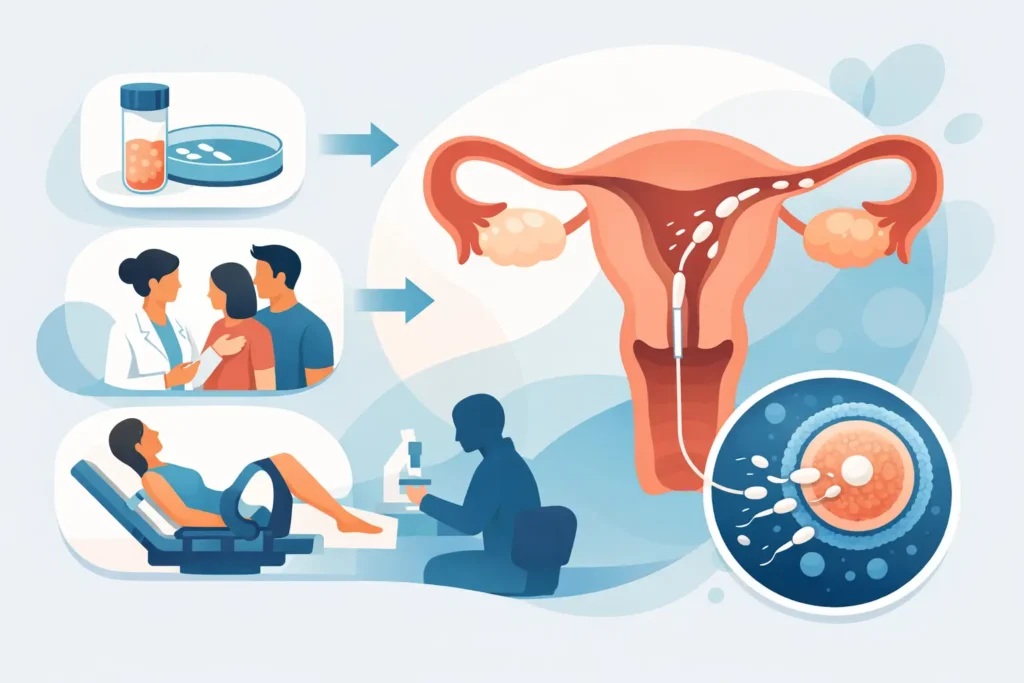
For many people, the uncertainty before fertility treatment can feel harder than the procedure itself. Knowing what happens during IUI treatment can make the process feel more manageable, from the first assessment through the two-week wait. IUI is usually a short, gentle procedure, but it is carefully timed and tailored to your fertility history, cycle, and test results.
Intrauterine insemination, or IUI, places prepared sperm directly into the uterus around the time of ovulation. This gives sperm a shorter path to the fallopian tube, where fertilization may take place naturally. Unlike IVF, fertilization and early embryo development occur inside the body.
Before IUI Treatment Begins
An IUI cycle starts with a specialist consultation and fertility assessment. Your care team needs to understand the possible reasons conception has not happened yet, as well as whether IUI is an appropriate next step.
For women, this may include a review of menstrual cycles, blood tests to assess hormones and ovarian reserve, pelvic ultrasound scans, and testing to confirm that at least one fallopian tube is open. IUI relies on sperm and egg meeting in the fallopian tube, so open tubes are essential for the treatment to have a reasonable chance of success.
For men, a semen analysis evaluates sperm count, movement, and shape. In some situations, further testing or a consultation with a male fertility specialist may be recommended. Screening for infectious diseases is also commonly required for both partners before treatment.
Your specialist will discuss whether a natural-cycle IUI or a medicated IUI is more suitable. The right approach depends on factors such as ovulation patterns, age, fertility diagnosis, prior treatment history, and how long you have been trying to conceive.
What Happens During IUI Treatment?
1. Your cycle is monitored
In a natural-cycle IUI, the clinic follows your usual ovulation pattern. You may use home ovulation tests, have blood tests, or attend ultrasound monitoring appointments to identify when an egg is likely to be released.
If ovulation is irregular, or if your specialist recommends a more controlled approach, medication may be used to encourage the development of one or more follicles. A follicle is a small fluid-filled sac in the ovary that contains an egg. Oral medications or injectable fertility medications may be prescribed, depending on your individual plan.
During a medicated cycle, ultrasound scans track follicle growth and check the uterine lining. These appointments allow the clinical team to adjust timing and reduce avoidable risks. If too many follicles develop, your specialist may advise postponing the cycle because multiple pregnancy carries greater health risks for both parent and babies.
2. Ovulation is timed carefully
Once a follicle reaches an appropriate size, ovulation may happen naturally or be triggered with an injection of human chorionic gonadotropin, often called a trigger shot. IUI is then scheduled close to ovulation, commonly about 24 to 36 hours after the trigger injection.
Timing matters because an egg is available for fertilization only for a limited window after ovulation. Sperm can survive longer in the reproductive tract, but IUI aims to place the prepared sperm in the uterus when the chance of meeting the egg is highest.
3. The sperm sample is prepared
On the day of insemination, a semen sample is collected, usually by masturbation in a private collection room or at home when the clinic’s timing and transport instructions can be followed. If donor sperm is being used, the sample is thawed and prepared according to established laboratory protocols.
The embryology or andrology laboratory then performs sperm washing. This process separates moving sperm from seminal fluid, debris, and less mobile sperm. Seminal fluid is not placed directly into the uterus because it can cause uncomfortable cramping. The final prepared sample is concentrated into a small volume for insemination.
It is normal to feel that this part of treatment is highly personal. A compassionate fertility team should explain collection requirements in advance and protect your privacy at every stage.
4. The insemination procedure takes only a few minutes
For the IUI itself, you will lie on an examination table, much like during a routine pelvic exam. A speculum is gently placed in the vagina so the cervix can be seen. Your specialist passes a very thin, flexible catheter through the cervix and into the uterus, then slowly releases the prepared sperm.
Most people describe the procedure as brief and tolerable. Some feel mild pressure, a quick cramp, or discomfort similar to a Pap test. The catheter is designed to be soft, and anesthesia is generally not needed. If pelvic exams have been painful or emotionally difficult for you in the past, tell your care team beforehand. Small adjustments, clear communication, and a slower pace can make a meaningful difference.
After the catheter is removed, you may rest for a few minutes before going home. There is no evidence that prolonged bed rest improves IUI outcomes. Most people return to normal daily activities the same day, although it can be reasonable to avoid strenuous exercise if your ovaries are enlarged from stimulation medication.
After the IUI: Symptoms, Medication, and the Wait
Light spotting or mild cramping after IUI can occur and is usually not a cause for concern. Some patients notice no symptoms at all. Neither the presence nor absence of symptoms can confirm whether pregnancy has occurred.
Your specialist may prescribe progesterone support after insemination, particularly in medicated cycles or where there is a reason to support the uterine lining. Take all medication exactly as directed, and ask before stopping it, even if you experience spotting.
The period between IUI and a pregnancy test is often called the two-week wait. It can bring hope, anxiety, and a strong urge to interpret every physical change. Try to remember that progesterone, ovulation, and early pregnancy can all cause similar symptoms, including breast tenderness, bloating, fatigue, and mood changes.
A home pregnancy test is typically recommended around 14 days after IUI, or on the date given by your clinic. Testing too early can create confusion. If you received a trigger shot, testing early may detect medication rather than a pregnancy because the injection contains hCG.
Contact your clinic promptly if you develop severe abdominal pain, significant bloating, shortness of breath, heavy bleeding, fainting, fever, or persistent vomiting. These symptoms are uncommon, but they need medical assessment, especially after injectable ovarian stimulation.
Who May Benefit From IUI?
IUI may be considered for unexplained infertility, ovulation difficulties, mild male-factor infertility, cervical-factor concerns, or when donor sperm is needed. It can also be an option for some same-sex couples and single intended parents, subject to local regulations and individual circumstances.
However, IUI is not the best fit for every fertility concern. It is generally less effective when both fallopian tubes are blocked, sperm parameters are severely reduced, endometriosis is advanced, or age-related fertility decline is a major factor. In these situations, IVF or another treatment may offer a more appropriate path.
Success rates vary widely. Age, egg quality, sperm quality, diagnosis, the number of follicles, and the use of medication all influence the likelihood of pregnancy. A specialist can help put statistics into context for your specific situation rather than relying on a single number found online.
Questions Worth Asking Before Your Cycle
Before starting, ask how your ovulation will be monitored, whether medication is recommended, what happens if more than one mature follicle develops, and when you should take a pregnancy test. You may also want to ask about the expected number of IUI cycles before your team reassesses the plan.
Many clinics review treatment after several unsuccessful cycles, but there is no universal timeline. Moving forward with another IUI, changing medication, or considering IVF should be a shared decision based on medical evidence, emotional readiness, finances, and your hopes for building a family.
IUI can be a relatively simple procedure, but the path to it is never just clinical. Give yourself permission to ask questions, take each appointment one step at a time, and lean on a fertility team that treats your concerns with the same care as your treatment plan.