



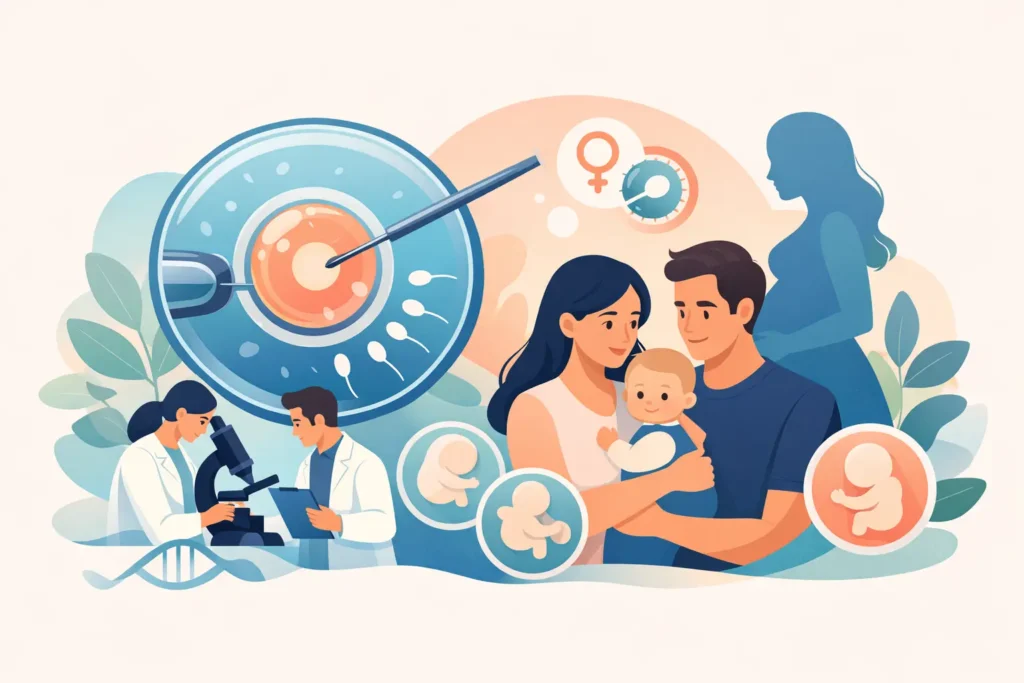
A child conceived through IVF may one day ask a question that matters deeply to many families: are IVF babies fertile? The reassuring answer is that IVF itself is not known to make a child infertile. Most people conceived through IVF are expected to have the same potential to become parents as anyone else. Still, fertility is personal, and a child’s future reproductive health can be influenced by factors that existed before IVF was ever used.
For parents who have worked hard to build a family, this is more than a scientific question. It can carry worries about passing on infertility or exposing a future child to a health concern. Understanding what research can tell us, and where its limits remain, can bring the question back to what it should be: a thoughtful conversation, not a source of blame or fear.
Are IVF Babies Fertile? The Short Answer
Current evidence does not show that being conceived by in vitro fertilization causes infertility. IVF helps sperm and egg meet in a laboratory, then supports the early embryo before it is transferred to the uterus. The treatment does not alter the basic reproductive organs or automatically determine the fertility of the child born.
The first IVF baby was born in 1978. That means the oldest people conceived through IVF are now in their late 40s, while many are still young adults or children. Researchers are therefore continuing to follow IVF-conceived people through adulthood, including their reproductive years. The findings available so far are broadly reassuring, but no responsible clinician should describe any individual’s future fertility as guaranteed.
Fertility naturally varies across the population. Some people conceive quickly, some need time, and some will need medical support, whether or not they were conceived through IVF. That variation is shaped by age, hormone function, sperm production, reproductive anatomy, lifestyle, medical history, and genetics.
The More Relevant Question: Why Was IVF Needed?
In many cases, a child’s future fertility is more closely connected to the reason their parents needed IVF than to IVF treatment itself. Infertility is not one diagnosis. It can result from blocked fallopian tubes, endometriosis, low sperm count, ovulation disorders, age-related changes, unexplained infertility, or a known genetic condition. Some of these causes are unlikely to affect a child. Others can have a hereditary component.
For example, polycystic ovary syndrome, endometriosis, early menopause in a family, and certain genetic conditions may occur more often among relatives. This does not mean a daughter or son will definitely experience the same condition. It means that family history may be useful information for their future healthcare team.
Male-factor infertility deserves similarly careful discussion. Some genetic changes linked to very low sperm production can be passed from a father to a son, particularly when intracytoplasmic sperm injection, or ICSI, is used. ICSI is a laboratory technique in which a single sperm is injected directly into an egg and is often recommended for specific sperm-related concerns. Where a severe sperm issue is present, genetic counseling and appropriate testing may help a couple understand possible implications before treatment.
This is not a reason to assume an IVF-conceived boy will be infertile. It is a reason to identify the underlying cause as clearly as possible and to discuss it honestly with a fertility specialist.
What Studies Say About Reproductive Health
Researchers have examined markers that can relate to reproductive function in young adults conceived through assisted reproduction. Studies of women conceived through IVF have generally found reassuring results for menstrual patterns, ovarian reserve markers, and early reproductive development. However, ovarian reserve tests are not a prediction of whether someone will conceive easily, and they are only one piece of a much larger clinical picture.
Research in men has also been largely reassuring, though studies are smaller and long-term data continue to develop. Some research has found differences in semen parameters among certain groups, while other studies have not found clinically meaningful differences. These findings can be difficult to interpret because the parents’ original fertility diagnosis, especially severe male-factor infertility, may influence the results.
Puberty, menstrual cycles, hormone levels, sperm count, and eventual ability to conceive are related but not identical measures. A normal puberty does not promise future fertility, and an abnormal test result does not always mean a person cannot become a parent. This is why broad claims based on a single study or test can create unnecessary worry.
IVF, ICSI, and Genetic Testing Are Different Things
People often use “IVF” as a catch-all term, but fertility treatment can involve several distinct procedures. Separating them helps make the question clearer.
Standard IVF refers to fertilization in the laboratory. ICSI is an additional technique used to assist fertilization when indicated. Preimplantation genetic testing, or PGT, examines embryos for specific genetic or chromosomal concerns before transfer. Frozen embryo transfer involves transferring an embryo that was cryopreserved earlier. None of these procedures should be assumed to cause infertility in a future child.
PGT can be especially meaningful when a parent carries a known inherited condition. It may help identify embryos that are less likely to be affected by that particular condition. Yet PGT does not test for every possible health or fertility issue, and it does not replace prenatal care or individualized genetic counseling.
There is ongoing scientific interest in how early embryo development, laboratory conditions, and epigenetic patterns may relate to long-term health. Epigenetics refers to changes in how genes are expressed rather than changes to the DNA sequence itself. This field deserves careful research, but it should not be confused with proof that IVF causes infertility. At present, evidence does not support that conclusion.
What Parents Can Do With This Information
Families do not need to treat an IVF birth as a reason to monitor a child’s fertility from infancy. Children conceived through IVF should receive the same routine pediatric, adolescent, and adult healthcare recommended for all children. As they mature, it can be helpful for them to know the basic facts of their family health history in an age-appropriate way.
If IVF was used because of a genetic condition, very low sperm count, premature ovarian insufficiency, or another diagnosis with possible inherited implications, keep a clear record of the diagnosis and any genetic test results. That information can be valuable if your child later has questions about family planning. Sharing it does not place a burden on them. It gives them the option to make informed decisions with their own doctor when the time is right.
A fertility consultation may be appropriate later in life if an adult conceived through IVF has irregular or absent periods, signs of hormonal concerns, a history of undescended testes or reproductive surgery, known genetic risks, or difficulty conceiving after trying. The timing depends on age and circumstances. For many people, there will be no reason to seek fertility testing until they are ready to plan a pregnancy.
When You Are Considering IVF Now
For people beginning fertility treatment, the question about a future child’s fertility is a good one to raise before a cycle starts. A specialist can explain the likely cause of infertility, whether genetic testing is relevant, and what is known about the particular treatment being recommended. The aim is not to promise certainty. It is to make decisions with the fullest, most accurate information available.
At IVcare Fertility, this conversation is part of individualized care. A treatment plan should consider not only how to achieve pregnancy, but also medical history, family history, genetic concerns, and the emotional weight of each choice.
IVF has helped many people welcome life’s most precious gift, and the evidence to date offers real reassurance about the fertility of children conceived this way. If this question is sitting heavily with you, bring it to a fertility specialist who can place it in the context of your own diagnosis, your family history, and the future you hope to build.