



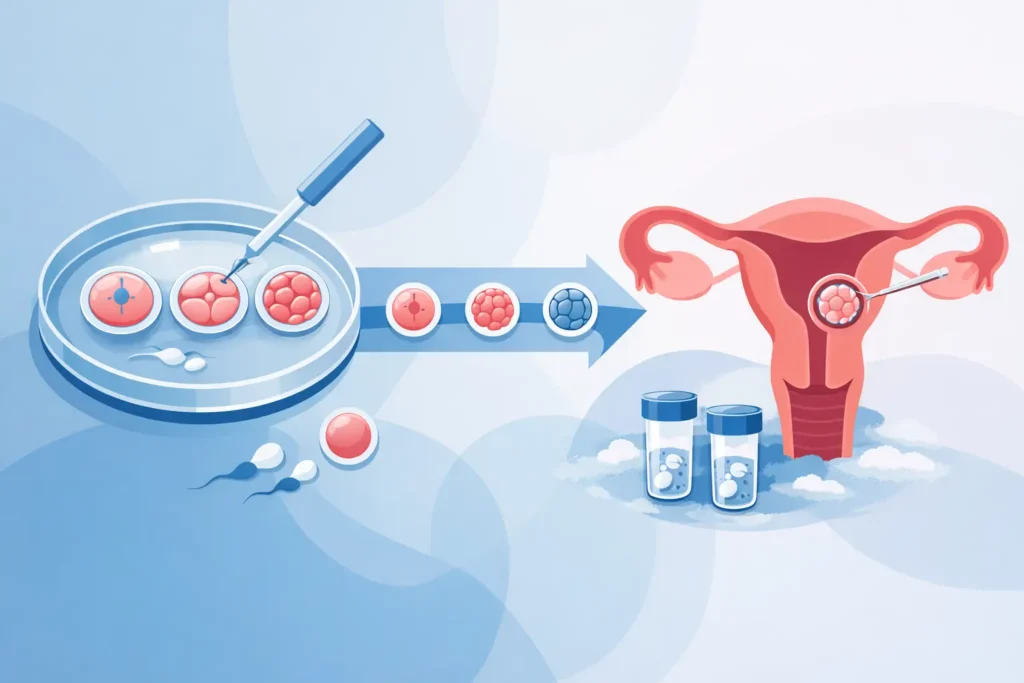
The days after egg retrieval can feel unexpectedly quiet. While you wait for updates from the embryology laboratory, one question often carries enormous weight: how many IVF fertilized eggs make it to transfer? The honest answer is that there is no single expected number. Each step from egg collection to embryo transfer is selective, and each embryo develops according to its own biology.
It can be difficult to hear that not every egg, fertilized egg, or early embryo will continue developing. But this natural attrition is a recognized part of IVF, not a sign that anything has gone wrong. Understanding the stages can make the waiting period clearer and help you have more grounded conversations with your fertility specialist.
From retrieved eggs to fertilized eggs
Egg retrieval is the first number many people focus on, but the total number of eggs collected is not the number of embryos available for transfer. Only mature eggs can be fertilized. Maturity is assessed in the laboratory, and the proportion of mature eggs varies with factors such as age, ovarian response, and the individual cycle.
Mature eggs may be fertilized through conventional IVF, where eggs and sperm are placed together in a laboratory dish, or intracytoplasmic sperm injection (ICSI), where a single sperm is injected into each mature egg. ICSI may be recommended in cases of male-factor infertility, previous low fertilization, or when eggs are being used for genetic testing.
The following day, embryologists check for normal fertilization. A normally fertilized egg usually shows two pronuclei, which contain genetic material from the egg and sperm. This is the starting point, but it is not yet a guarantee that an embryo will reach the stage suitable for transfer or freezing.
Why fertilized eggs do not all reach transfer
After fertilization, embryos divide from one cell into two, then four, eight, and beyond. Some stop developing early. Others continue but do not form a blastocyst, the more advanced embryo stage commonly reached around day 5 or day 6. This process reflects the embryo’s developmental potential, including factors that cannot be seen simply by looking at the egg or sperm.
Chromosomal differences are one major reason embryos may arrest or may not be suitable for transfer. These differences become more common as egg age increases, although they can occur at any age. Sperm factors, egg quality, laboratory conditions, and chance also influence development.
For this reason, a funnel-shaped pattern is common in IVF: some retrieved eggs are mature, some mature eggs fertilize normally, and some fertilized eggs become usable embryos. It is not possible to predict the final number with certainty from the egg count alone.
As a broad guide, fertility teams may see normal fertilization in roughly 60% to 80% of mature eggs, though individual results can fall outside this range. Of the normally fertilized eggs, only a proportion will develop into blastocysts. The percentage can vary substantially, especially according to maternal age and the reason for treatment. These figures are reference points, not promises or a measure of whether a cycle has been successful.
How many IVF fertilized eggs make it to transfer?
A transfer may involve one embryo, even when more than one embryo develops. In modern IVF care, elective single embryo transfer is often recommended because transferring more than one embryo increases the likelihood of twins or higher-order multiple pregnancy. Multiple pregnancies carry greater risks for both the pregnant person and babies, including premature birth and pregnancy complications.
That means the better question is often not only how many fertilized eggs make it to transfer, but how many good-quality embryos are available for a safe, well-planned transfer strategy. One embryo can be transferred in a fresh cycle when clinically appropriate, while additional suitable embryos may be cryopreserved for a future frozen embryo transfer.
A day 3 transfer may be considered in certain circumstances, particularly when there are few embryos available or when the care team believes it is the most appropriate plan. More commonly, clinics culture embryos to the blastocyst stage. Reaching day 5 or day 6 gives embryologists more information about development and allows closer coordination with embryo freezing or preimplantation genetic testing.
What embryo grading can and cannot tell you
Embryologists assess embryos using recognized grading systems. At the blastocyst stage, grading considers expansion and the appearance of the inner cell mass, which develops into the fetus, and the trophectoderm, which contributes to the placenta. A higher grade can be encouraging, but grading is not a verdict on an embryo’s ability to result in a healthy baby.
Embryo appearance does not reveal every genetic detail. An embryo that looks excellent may have a chromosomal difference, while a lower-graded embryo may still lead to a healthy pregnancy. When appropriate, preimplantation genetic testing for aneuploidy (PGT-A) can provide additional information about chromosome number. It may be discussed for people with recurrent pregnancy loss, repeated IVF setbacks, advancing maternal age, or specific clinical circumstances.
PGT-A is not necessary for every patient, and it does not improve every outcome for every group. It also requires embryos to reach blastocyst stage for biopsy and is usually paired with frozen embryo transfer. Your specialist can help weigh the possible benefits, limitations, cost, and timing based on your history.
A small number can still hold real hope
It is understandable to compare your results with figures shared online or by friends. Yet IVF outcomes are deeply individual. Someone may retrieve many eggs and have few blastocysts, while another may retrieve a smaller number and have one embryo that leads to a healthy pregnancy. Neither story can predict yours.
If only one or two eggs fertilize, your team may continue monitoring their development with the same care as they would a larger group. If no embryos reach transfer, the cycle still provides clinically useful information. Your fertility specialist may review egg maturity, fertilization method, sperm parameters, embryo development pattern, medication response, and whether further testing or a different protocol could be helpful.
There are occasions when no transfer occurs in a particular cycle because the uterus needs more time to prepare, hormone levels suggest a frozen transfer would be preferable, or PGT results are pending. A delayed transfer can feel disappointing, but it may be a thoughtful decision intended to support the best possible conditions for implantation.
Questions worth bringing to your IVF review
A clear review with your fertility team can replace assumptions with a plan. Ask how many eggs were retrieved and mature, how many fertilized normally, how embryos progressed on day 3 and day 5 or 6, and whether any were frozen. It is also reasonable to ask what the team learned from this cycle and whether they recommend a fresh transfer, frozen embryo transfer, additional treatment, or further investigation.
Emotional support matters here too. Waiting for embryo updates can bring hope, grief, relief, and anxiety in the same day. You do not need to minimize those feelings to be “positive.” A compassionate fertility care team should explain the science clearly while recognizing what these numbers represent to you.
At IVcare Fertility, treatment planning is centered on your medical history, laboratory findings, and family-building goals, rather than a generic target number. Whether you have several embryos, one embryo, or need time to consider next steps, the next conversation should leave you with clearer choices and continued support for the path ahead.