



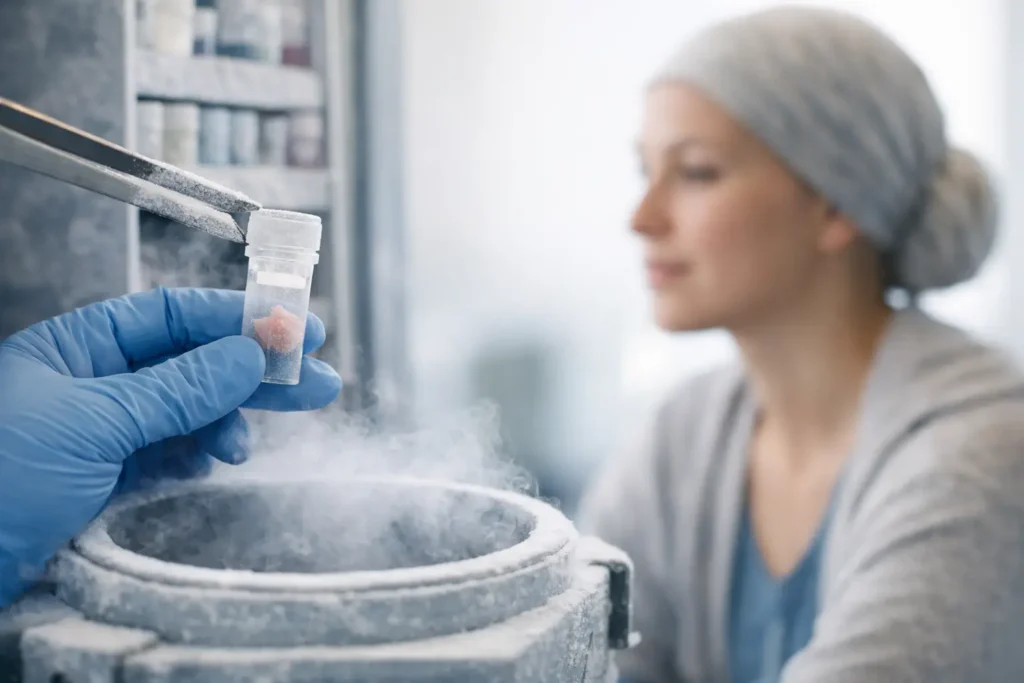
A cancer diagnosis can make the future feel suddenly uncertain. For patients who may want children later, ovarian tissue freezing before chemotherapy can offer a time-sensitive way to protect the possibility of pregnancy before treatment begins. It is not a guarantee of future fertility, but for some patients, it can preserve an opportunity that chemotherapy may otherwise reduce.
Chemotherapy is often essential and should never be delayed without careful coordination with your oncology team. The goal of fertility preservation is to work alongside cancer care, creating a plan that protects both your health now and your reproductive options later.
Why chemotherapy can affect fertility
Many chemotherapy medicines work by targeting rapidly dividing cells. While this is central to treating cancer, some medications can also damage the eggs stored in the ovaries. The effect varies widely depending on the drug type, total dose, treatment duration, and a patient’s age and existing ovarian reserve.
Some people resume periods after treatment and still experience a reduced egg supply. Others may develop primary ovarian insufficiency, sometimes called early menopause. Menstrual bleeding alone does not always show whether fertility has been fully preserved, which is why a fertility consultation before treatment can be valuable even when the risk feels uncertain.
Your oncology and fertility teams can review the proposed treatment plan together. This helps identify whether the fertility risk is low, moderate, or high, while ensuring that cancer treatment remains the priority.
What ovarian tissue freezing involves
Ovarian tissue cryopreservation is a surgical fertility-preservation procedure. A fertility specialist removes part or, less commonly, all of one ovary through minimally invasive surgery. The outer layer of the ovary, called the cortex, contains many immature eggs within tiny follicles.
In the laboratory, the ovarian cortex is carefully divided into small pieces and frozen for long-term storage. Unlike egg freezing, the eggs in ovarian tissue are immature and remain within their natural ovarian environment. They are not collected through ovarian stimulation or a vaginal egg-retrieval procedure.
After cancer treatment and when pregnancy is medically appropriate, the frozen tissue may be thawed and transplanted back into the body. The aim is for the tissue to restore hormone production and potentially allow follicles to mature and release eggs. Some patients may conceive naturally after transplantation, while others may use IVF depending on their circumstances.
Who may benefit from ovarian tissue freezing before chemotherapy?
This option may be particularly helpful when treatment needs to begin quickly. Egg or embryo freezing usually requires approximately two weeks of ovarian stimulation before retrieval. Ovarian tissue freezing can often be arranged in a shorter timeframe, making it worth discussing when there is limited time before chemotherapy.
It may also be considered for people who cannot or prefer not to undergo hormone stimulation, and for prepubertal girls facing gonadotoxic cancer treatment. For adult patients, suitability depends on age, ovarian reserve, cancer type, and the likelihood that the disease could involve the ovaries.
A specialist will also consider whether reimplanting tissue later would be medically safe. In certain blood cancers and cancers with a higher risk of ovarian involvement, transplanting ovarian tissue may carry a risk of reintroducing malignant cells. Research and laboratory screening continue to advance, but this concern must be addressed individually and openly.
Timing matters, but so does coordination
The most useful time to ask about fertility preservation is before chemotherapy, pelvic radiation, or surgery that may affect the reproductive organs. Ideally, a referral to a fertility specialist happens as soon as cancer treatment is being planned, not after a final schedule has been set.
The procedure itself generally involves a short laparoscopic operation under anesthesia. Recovery is usually brief, but every surgical decision must be weighed against the urgency of starting cancer treatment and a patient’s overall health. Your oncology team, surgeon, and fertility specialist should agree on a timeline that does not compromise essential care.
For many patients, the process involves an expedited consultation, blood tests and an ultrasound where appropriate, preoperative assessment, surgery, laboratory processing, and storage. The details can move quickly, which is why clear explanations and emotional support matter just as much as clinical efficiency.
Ovarian tissue freezing compared with egg and embryo freezing
There is no single best fertility-preservation option for every person. Egg freezing collects mature eggs after hormonal stimulation. Embryo freezing combines eggs with sperm before freezing and may be suitable for people who are ready to make decisions about sperm use and future embryo disposition.
Ovarian tissue freezing does not require stimulation and can be an option when time is short. It may also have the added potential of restoring ovarian hormone function after transplantation, which can be meaningful for patients affected by treatment-related menopause.
There are trade-offs. Ovarian tissue freezing requires surgery now and another procedure if transplantation is planned later. Not all tissue survives the freeze-thaw process or functions for the same length of time after transplant. Success is influenced by the amount and quality of tissue collected, age at freezing, underlying diagnosis, and the technique used by the clinical and laboratory teams.
In some situations, a patient may be able to combine approaches, such as freezing eggs or embryos as well as ovarian tissue. This is a personal medical decision shaped by treatment timing, prognosis, finances, relationship circumstances, and future family-building goals.
Questions to bring to your fertility consultation
A fertility-preservation appointment should give you room to understand the medical facts without feeling rushed into a choice. Consider asking:
- How likely is my planned chemotherapy to affect ovarian function and fertility?
- Is ovarian tissue freezing suitable for my cancer type and treatment timeline?
- Could egg freezing or embryo freezing also be possible before treatment starts?
- What are the surgical risks, storage arrangements, future transplant considerations, and expected costs?
It can also help to ask what support is available if you are feeling overwhelmed. A cancer diagnosis and fertility decisions can bring grief, urgency, hope, and uncertainty at the same time. There is no correct emotional response, and you do not need to have every future decision resolved before speaking with a specialist.
Planning for life after treatment
Frozen ovarian tissue is stored until you are ready to revisit your options and your medical team confirms that doing so is appropriate. That conversation may happen years later. At that point, fertility testing, cancer follow-up, age, partner circumstances, and your own plans will all guide the next step.
Some people eventually choose tissue transplantation. Others may use previously frozen eggs or embryos, consider donor treatment, or find that their ovarian function has recovered sufficiently to try for pregnancy without fertility treatment. Fertility preservation creates options, not obligations.
At IVcare Fertility in Petaling Jaya, a specialist-led consultation can help patients understand whether ovarian tissue cryopreservation fits safely within their cancer-care timeline. The focus is on an individualized plan, coordinated communication, and compassionate guidance through a decision that can feel deeply personal.
If chemotherapy is approaching, ask your oncologist for a fertility-preservation referral as soon as possible. Even when time is limited, one timely conversation can help protect space for the new beginnings you may wish to consider when treatment is behind you.