



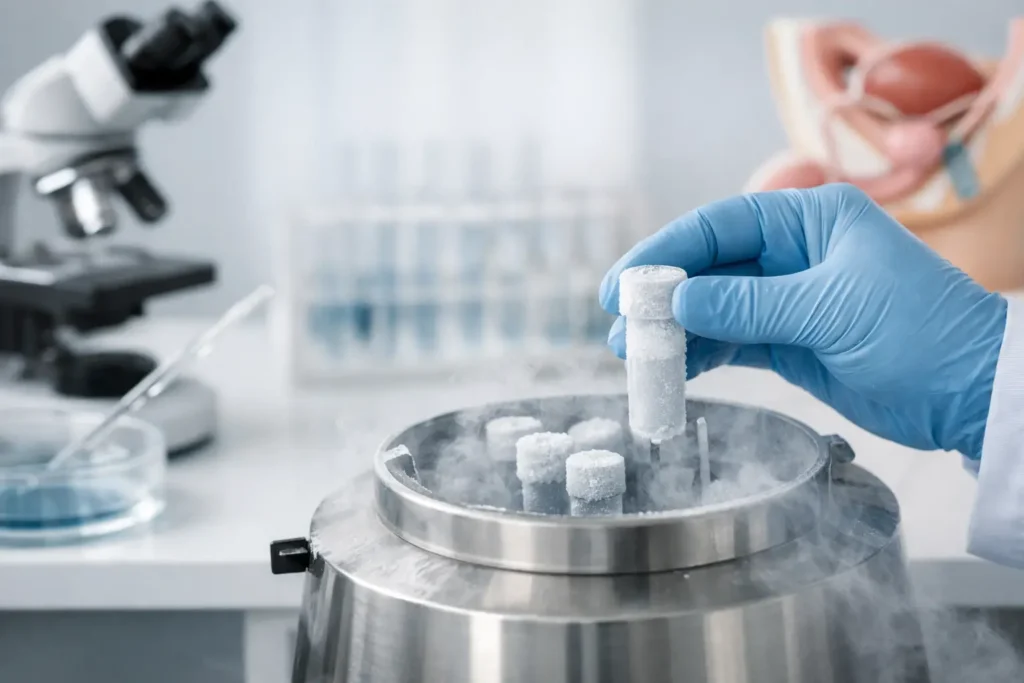
A cancer diagnosis can make the future feel suddenly uncertain. While the priority is always starting effective care without unnecessary delay, sperm freezing before cancer treatment may give you an important choice later: the possibility of using your own sperm to build a family when you are ready.
This is not a decision that requires you to know whether you want children, or exactly when. It is a way of preserving options at a time when cancer treatment may affect sperm production or sexual function. A fertility specialist can work alongside your oncology team to organize preservation quickly, safely, and with sensitivity to the treatment timeline.
Why cancer treatment can affect fertility
Some cancer treatments can temporarily or permanently reduce fertility. The effect depends on the cancer type, your age and baseline sperm health, the specific medicines or radiation dose, and whether surgery involves reproductive organs or nearby nerves.
Chemotherapy medicines can damage the cells in the testes that produce sperm. Some treatments carry a higher risk than others, and recovery after treatment is unpredictable. Sperm production may return months or years later for some men, while for others it may remain low or stop altogether.
Radiation to the pelvis, testes, brain, or whole body can also affect sperm production and hormone signaling. Surgery for cancers involving the testes, prostate, bladder, bowel, or pelvic area may affect ejaculation, erections, or the ability to produce sperm. Even when treatment is not directly aimed at the reproductive system, illness, surgery, and medication can influence fertility.
Your oncologist can explain the expected risk from your treatment plan. A reproductive specialist can then explain whether semen cryopreservation is appropriate and how it can fit within the available time.
What sperm freezing before cancer treatment involves
Sperm freezing, also called semen cryopreservation, is the collection, testing, and storage of sperm at very low temperatures. The process is well established and is usually straightforward.
Most people provide a semen sample through masturbation in a private collection room at the fertility clinic. The laboratory assesses key features such as sperm concentration, movement, and appearance. The sample is then divided into small, labeled storage units and frozen using carefully controlled laboratory methods.
When the sperm is needed in the future, a sample can be thawed for fertility treatment. Depending on the quality and number of available sperm, it may be used for intrauterine insemination, IVF, or intracytoplasmic sperm injection, commonly called ICSI. With ICSI, an embryologist injects one sperm directly into an egg, which can make it possible to use very small numbers of viable sperm.
How many samples are needed?
If time allows, two or three samples collected on different days can provide more stored sperm and greater flexibility later. However, one sample is still worth preserving when treatment must begin quickly. It is better to discuss the available window promptly than to assume there is not enough time.
Clinics may suggest abstaining from ejaculation for two to five days before a collection to optimize the sample. Yet cancer treatment schedules come first. If a shorter abstinence period or same-day collection is necessary, the care team can advise on the most practical approach.
What if you cannot provide a sample?
There are alternatives for men who cannot ejaculate because of illness, pain, anxiety, erectile difficulties, prior surgery, or a spinal cord condition. In selected circumstances, sperm may be retrieved directly from the testes through a minor procedure. This is known as surgical sperm retrieval.
Not every approach is suitable for every person, and the choice depends on your health, diagnosis, blood counts, and time before cancer therapy. A fertility specialist and oncologist should coordinate closely, particularly when a procedure or sedation may be needed.
Timing matters, but you do not need to manage it alone
The ideal time to freeze sperm is before chemotherapy, radiation, or surgery that could affect fertility. Once treatment starts, sperm quality and genetic integrity may be affected, and collection may not be recommended. A new semen sample obtained after treatment should not be assumed to be safe or suitable until your oncology and fertility teams advise you.
A referral should happen as soon as cancer treatment is being planned, not after the first treatment session. In many cases, sperm freezing can be arranged within days and does not require weeks of preparation. Your oncology team can help identify whether there is time to collect more than one sample without compromising the cancer plan.
There can be situations where treatment is urgent and the window is very short. In that case, a single collection, or discussion of surgical retrieval, may be considered. The right decision is not about achieving a perfect fertility-preservation plan. It is about making the best possible plan within the realities of your medical care.
Questions to ask at your fertility consultation
A consultation should give you clear answers, not add pressure. It can help to ask how your specific cancer treatment may affect fertility, how quickly collection can be arranged, and whether more than one sample is realistic.
You may also want to ask how the samples will be tested, how long they can be stored, and which future treatments may be possible with the number and quality of sperm frozen. Storage fees, consent forms, and what happens if your circumstances change are also worth discussing before storage begins.
If you have a partner, you may choose to involve them in the conversation. But the stored sperm remains a deeply personal decision, and consent arrangements should be explained clearly. Ask about renewing storage consent and how you can update your contact details or instructions over time.
What sperm freezing can and cannot promise
Sperm freezing preserves a possibility, not a guarantee of pregnancy. Future success depends on the quality of the sample before freezing, how many samples are stored, the age and reproductive health of the person providing eggs, and the fertility treatment used later.
That said, cryopreservation can be valuable even when a semen analysis shows low count or reduced movement. Advanced laboratory techniques, particularly IVF with ICSI, may allow usable sperm to support fertilization when simpler treatments would not be appropriate.
It is also understandable to feel unsure about preserving fertility while facing decisions about cancer. Some people know they want children. Others do not, or worry that planning for a future feels difficult while treatment is imminent. There is no required emotional response. The purpose of the discussion is to ensure that you have informed choices before a treatment that may limit them.
Coordinated care protects both your health and your options
Fertility preservation should never compete with cancer care. The goal is timely coordination: your oncology team treats the cancer, while your fertility team helps safeguard reproductive options where possible. Share your treatment dates, diagnosis, and medications with the fertility clinic so the teams can plan responsibly.
At IVcare Fertility, semen cryopreservation is approached as part of a personalized care pathway, with attention to the clinical details as well as the emotional weight of the decision. Whether you are collecting one urgent sample or considering surgical sperm retrieval, compassionate guidance can make the process feel more manageable.
You do not need to have your future mapped out before taking this step. Asking about fertility preservation now can give the future version of you one more choice – and, for many people, a meaningful source of hope while treatment begins.