



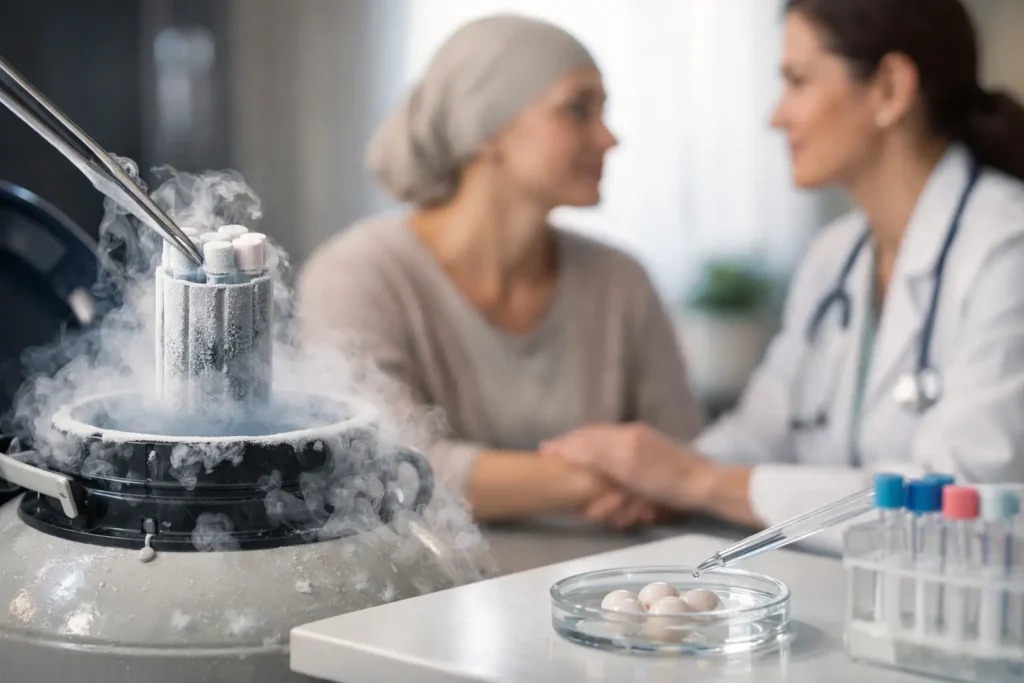
A cancer diagnosis can make time feel suddenly urgent. Amid scans, treatment schedules, and difficult conversations, egg freezing before chemotherapy may offer a meaningful way to preserve the possibility of having a genetically related child in the future. It is not a promise of pregnancy, and it should never delay essential cancer care without your oncology team’s agreement. But for many women, it creates space for hope beyond treatment.
Chemotherapy can affect the ovaries in different ways, depending on the medicines used, the total dose, your age, and your existing ovarian reserve. Some people regain menstrual cycles after treatment, while others experience reduced fertility or early menopause. Having a fertility preservation conversation before treatment begins gives you more choices when time matters most.
Why chemotherapy can affect fertility
The ovaries contain a lifetime supply of immature eggs. Certain chemotherapy medicines can damage these eggs and the cells that support them. This may lower the number of eggs remaining after treatment and can sometimes stop ovarian function permanently.
The level of risk varies considerably. Alkylating agents, for example, are generally associated with a higher risk of ovarian damage than some other chemotherapy drugs. Radiation involving the pelvis or abdomen, ovarian surgery, stem cell transplant conditioning, and certain targeted treatments may also affect fertility. Your oncologist can explain the planned treatment, while a fertility specialist can help translate that plan into personal fertility considerations.
Age is also part of the picture. A woman in her early 30s may have a different ovarian reserve and recovery outlook than someone in her early 40s receiving the same treatment. That is why an individualized assessment is more useful than broad assumptions about whether fertility will or will not return.
How egg freezing before chemotherapy works
Egg freezing, also called oocyte cryopreservation, involves collecting mature eggs and freezing them for possible use later. If you decide to use the eggs in the future, they are thawed, fertilized in an IVF laboratory, and transferred as an embryo into the uterus.
The process begins with a prompt consultation and fertility assessment. This commonly includes an ultrasound to look at the ovaries and blood tests that help estimate ovarian reserve. Your fertility specialist will also review your cancer diagnosis, planned treatment, medical history, and the timeline advised by your oncology team.
You will then take hormone injections for approximately 10 to 14 days to encourage multiple eggs to mature in one cycle. During this period, the clinic monitors follicle growth with ultrasounds and blood tests, adjusting medication when needed. When the eggs are ready, a final trigger injection prepares them for collection.
Egg retrieval is a short procedure performed under sedation or anesthesia. Using ultrasound guidance, the doctor collects eggs from the ovaries through the vagina. Mature eggs are then frozen using vitrification, a rapid freezing method designed to protect them during storage.
For many patients, one cycle can be completed in about two weeks. In urgent situations, stimulation can often start at different points in the menstrual cycle rather than waiting for the next period. However, the right timing depends on your diagnosis and treatment plan. Your cancer treatment team must remain closely involved throughout the decision.
Can hormone stimulation be used with hormone-sensitive cancer?
This is a common and understandable concern, particularly for women diagnosed with certain breast cancers. Egg-freezing medications temporarily raise hormone levels, but fertility specialists can use protocols that include medications such as letrozole to help limit estrogen exposure in appropriate patients.
Whether this approach is suitable depends on your cancer type, stage, treatment urgency, and oncologist’s recommendations. A coordinated discussion between your oncologist and fertility specialist is essential. Fertility preservation should fit safely around cancer treatment, not compete with it.
What egg freezing can and cannot offer
Frozen eggs preserve potential, not certainty. The likelihood of a future live birth depends on several factors, including your age when the eggs are frozen, the number of mature eggs collected, how eggs survive warming, fertilization results, embryo development, and your health when you are ready to pursue pregnancy.
Generally, eggs frozen at a younger age have a higher chance of leading to a healthy embryo than eggs frozen later. Still, there is no exact number of eggs that guarantees a baby. Your specialist can discuss realistic expectations based on your ovarian reserve and age, including whether one stimulation cycle is likely to be enough or whether a second cycle might be considered if time permits.
Egg freezing also does not protect against every reproductive challenge that may arise later. Cancer treatment, surgery, radiation, or health changes can affect the uterus, pregnancy safety, or the ability to carry a pregnancy. For some people, a future pregnancy may require additional medical planning. These possibilities are reasons for clear counseling, not reasons to lose hope.
Egg freezing, embryo freezing, and other options
If you have a partner or wish to use donor sperm, embryo freezing may be another option. Embryos can offer additional information about development after fertilization, but they involve important personal, legal, and emotional decisions about future use, storage, and consent. Egg freezing may feel more appropriate for people who want to preserve reproductive autonomy without creating embryos now.
For some patients, ovarian tissue cryopreservation may be discussed. In this procedure, ovarian tissue containing immature eggs is surgically removed and frozen before treatment. It may be particularly relevant when chemotherapy must start too quickly for an egg-freezing cycle, or for patients who cannot undergo ovarian stimulation. It is a specialist option with its own benefits, limitations, and suitability criteria.
Medication to temporarily suppress ovarian function during chemotherapy may also be considered in some circumstances. It may help reduce the risk of treatment-related ovarian failure, but it is not a replacement for freezing eggs or embryos when fertility preservation is a priority.
Questions to ask at your first fertility consultation
You do not need to have every answer before asking for help. It can be useful to bring your oncology treatment plan and ask how urgently chemotherapy needs to begin, whether a two-week fertility preservation cycle is medically appropriate, and how your specific treatment may affect ovarian function.
Ask what number of mature eggs might be realistic in your situation, whether low-estrogen stimulation is relevant to your diagnosis, and what the procedure, medication, storage, and future IVF costs involve. You may also want to discuss how long eggs can be stored, what happens to them if your circumstances change, and who can make decisions about them in the future.
A supportive clinic should make room for these practical questions as well as the emotional ones. Fear, grief, uncertainty, and even guilt about considering future fertility during cancer treatment are all valid responses. Preserving fertility is not a distraction from getting well. For many people, it is part of caring for the life they hope to return to.
Acting quickly without feeling rushed
The best time to ask about fertility preservation is before chemotherapy begins, ideally as soon as cancer treatment is being planned. A same-week referral can make a significant difference, especially when care is coordinated efficiently between oncology and fertility teams.
At IVcare Fertility in Petaling Jaya, a specialist-led consultation can help clarify whether egg freezing fits your medical timeline and personal goals. The purpose is not to pressure you into treatment. It is to give you understandable information, a tailored plan where appropriate, and compassionate support while you make a decision in an exceptionally demanding moment.
You may not be ready to decide what family-building will look like years from now. You only need to know that asking about your options now can protect a choice for later – when recovery, new beginnings, and life beyond cancer are allowed to take center stage.