



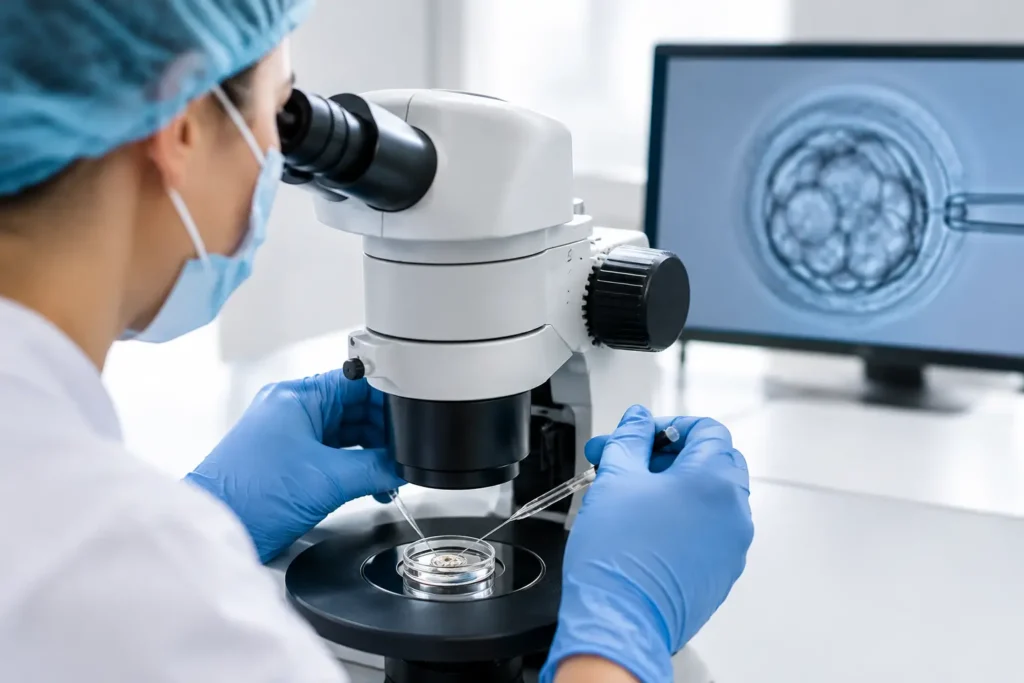
An embryo biopsy is a small but meaningful step within an IVF cycle. It allows an embryology team to collect a few cells from an embryo for preimplantation genetic testing (PGT), giving your fertility specialist more information when planning which embryo may be suitable for transfer.
For many people, this information can bring clarity after miscarriage, unsuccessful fertility treatment, or a known inherited genetic condition. For others, it may not add enough value to justify the cost, time, and complexity. The right decision depends on your medical history, age, embryo numbers, family-planning goals, and what you hope genetic testing can answer.
What happens during embryo biopsy?
Embryo biopsy is performed in an IVF laboratory after eggs have been collected, fertilized, and allowed to develop under carefully controlled conditions. Most biopsies are carried out when an embryo reaches the blastocyst stage, usually around day five, six, or sometimes seven of development.
At this stage, the embryo contains two distinct cell groups. The inner cell mass is the group of cells that may develop into the fetus. The outer layer, called the trophectoderm, is involved in forming the placenta. Using specialized equipment, an experienced embryologist removes a small number of cells from the trophectoderm for testing.
The embryo is then cryopreserved while the laboratory analyzes the sample. If a suitable embryo is identified, it can later be thawed for a frozen embryo transfer. This approach gives the care team time to review results with you carefully rather than making rushed decisions during an active IVF cycle.
A biopsy is designed to minimize disruption to embryo development. However, no medical procedure is entirely without risk. Embryo handling, freezing, thawing, and testing are all highly specialized processes, which is why laboratory standards and embryology expertise matter greatly.
Why embryo biopsy may be recommended
PGT is not automatically recommended for every IVF patient. It is usually considered when the potential information gained may meaningfully guide treatment decisions.
PGT for aneuploidy, often called PGT-A, screens for embryos with an unexpected number of chromosomes. Chromosome differences can contribute to failed implantation, miscarriage, or conditions such as Down syndrome. PGT for monogenic conditions, or PGT-M, is used when one or both intended parents carry a known single-gene condition that could be passed on to a child. PGT for structural rearrangements, known as PGT-SR, may be considered when a parent has a chromosome rearrangement.
Your specialist may discuss embryo biopsy if you have experienced recurrent miscarriage, repeated embryo-transfer failure, a previous pregnancy affected by a chromosome condition, or a known genetic condition in your family. It may also be part of a tailored discussion for patients of advanced reproductive age, when the likelihood of chromosomal differences in embryos rises.
Still, a recommendation is not the same as a requirement. Someone with a small number of embryos may choose to proceed with transfer without PGT, while another patient may feel that genetic information would help them make decisions with greater confidence. Both perspectives deserve thoughtful, individualized counseling.
What PGT results can and cannot tell you
PGT results are commonly reported in categories that help guide embryo-transfer planning. An embryo may be reported as euploid, meaning the tested cells show the expected number of chromosomes, or aneuploid, meaning a chromosome difference was detected. Some results may be described as mosaic, meaning the tested sample contains a mix of cells with different chromosome findings.
A euploid result can help identify embryos that may have a higher chance of implantation and a lower risk of miscarriage related to chromosome number. It does not guarantee pregnancy, a healthy birth, or the absence of every medical condition. Implantation also depends on factors such as uterine health, hormone preparation, embryo development, and aspects of biology that testing cannot fully predict.
An aneuploid result may indicate that an embryo is unlikely to lead to an ongoing pregnancy. Yet results must always be interpreted in clinical context, particularly when a finding is complex or when few embryos are available.
Mosaic results require especially careful discussion. Because a biopsy samples a small number of trophectoderm cells rather than every cell in the embryo, the result may not perfectly represent the inner cell mass. Some mosaic embryos may still have reproductive potential, but decisions about their use should be guided by a fertility specialist, genetic counselor where appropriate, and current clinical recommendations.
PGT also does not assess every possible genetic or developmental concern. Unless a specific test is arranged, it does not diagnose all single-gene conditions, birth defects, autism, intelligence, or future health outcomes. Prenatal screening and, when advised, diagnostic testing during pregnancy remain important parts of care after a PGT-assisted conception.
The trade-offs to consider before testing
The benefits of embryo biopsy are often clearest when testing addresses a specific clinical concern. It can help prioritize embryos for transfer and may reduce the uncertainty of choosing among several embryos. For people affected by an inherited condition, PGT-M can offer a path toward building a family while seeking to reduce the chance of passing on that condition.
There are trade-offs, too. PGT adds cost to an IVF cycle and usually means embryos are frozen while results are processed. Not every embryo reaches the blastocyst stage for biopsy, and not every biopsied embryo receives a clear or transferable result. This can feel particularly difficult after a cycle that produces only one or two embryos.
Testing may also reveal information that is emotionally challenging, including the possibility that no embryos are suitable for transfer based on the selected testing criteria. Before starting, it helps to discuss how you might feel about different outcomes and what your next options could be.
For PGT-M, planning often begins before IVF. The testing laboratory may need to create a personalized test for your family’s known genetic variant, which can take time. If donor eggs, donor sperm, or a gestational carrier are being considered, these details can also affect the testing and treatment plan.
Questions worth discussing with your fertility specialist
A good consultation should leave room for your questions, not simply present a testing recommendation. Ask why PGT is being considered in your particular case and whether it is intended to screen for chromosome number, test for a known inherited condition, or assess a chromosome rearrangement.
It is also reasonable to ask about the expected number of embryos available for biopsy, how results are reported, how mosaic findings are managed, and what would happen if no embryos are recommended for transfer. Understanding the laboratory process, expected timeline, costs, and whether genetic counseling is advised can help you make a decision that feels informed rather than pressured.
At IVcare Fertility, these conversations are part of building a treatment plan around the person or couple behind the test results. Fertility care is deeply personal, and advanced technology is most helpful when it is paired with clear explanations and compassionate support.
Embryo biopsy is not a promise of a particular outcome. It is a tool that can offer valuable information at an important point in your IVF journey. Taking time to understand what it can answer, what it cannot, and how the results would shape your next step can help you move forward with greater clarity and hope.