


For someone who has spent months or years managing pelvic pain, heavy periods, or the uncertainty of trying to conceive, the question “does endometriosis affect egg quality” can feel deeply personal. The short answer is that it can be associated with changes that may affect an egg’s potential, particularly in more advanced disease. But endometriosis does not mean every egg is unhealthy, nor does it mean pregnancy is out of reach.
Fertility is shaped by several factors at once: age, ovarian reserve, sperm health, fallopian tube function, the uterus, the severity and location of endometriosis, and the treatment approach. A careful assessment helps turn a worrying question into a plan built around your individual circumstances.
What doctors mean by egg quality
Egg quality describes an egg’s ability to mature, be fertilized, develop into an embryo, and potentially lead to a healthy pregnancy. Chromosomal health is an important part of this. Age remains the strongest predictor of egg quality because the likelihood of chromosomal errors in eggs rises over time.
Egg quality is often confused with ovarian reserve. Ovarian reserve refers to the estimated number of eggs remaining in the ovaries. Tests such as anti-Mullerian hormone (AMH), antral follicle count on ultrasound, and follicle-stimulating hormone testing can help estimate reserve. They cannot directly measure whether an individual egg is chromosomally normal.
In an IVF cycle, the laboratory team can observe useful signs, including how many eggs are mature, whether fertilization occurs, and how embryos develop over several days. These observations offer information, but they are not a perfect, direct test of egg quality. Preimplantation genetic testing for aneuploidy (PGT-A), when clinically appropriate, can assess the chromosomes in embryos, not in eggs themselves.
How endometriosis may influence eggs and fertility
Endometriosis occurs when tissue similar to the lining of the uterus grows outside the uterus. It may involve the ovaries, fallopian tubes, pelvic lining, bowel, or bladder. Some people have significant symptoms, while others first learn they have endometriosis during a fertility assessment.
Research suggests that endometriosis may affect the environment around developing eggs. Inflammation within the pelvis, oxidative stress, and changes in immune signaling may interfere with normal follicle development in some patients. These processes may affect egg maturation or the ability of an embryo to develop after fertilization.
The effect is not uniform. Someone with mild endometriosis may have a very different fertility picture from someone with large ovarian endometriomas, extensive adhesions, or repeated unsuccessful treatment cycles. Some patients with endometriosis conceive naturally; others benefit from treatment because the disease affects more than one part of reproduction at once.
Ovarian endometriomas deserve special attention
An endometrioma is an endometriosis-related cyst within the ovary, sometimes called a chocolate cyst. It can affect ovarian tissue and may be linked with a lower response to ovarian stimulation during IVF, especially when cysts are large, present in both ovaries, or have required previous surgery.
Surgery can be valuable when an endometrioma causes substantial pain, has concerning features, interferes with egg retrieval, or needs clearer diagnosis. However, surgery on the ovary may also reduce ovarian reserve by removing or affecting healthy ovarian tissue. This is why the decision is never automatic. A fertility specialist considers cyst size, symptoms, ultrasound findings, age, ovarian reserve, prior surgery, and how soon you hope to conceive.
Does endometriosis affect egg quality in every IVF cycle?
No. Endometriosis is associated with lower egg yield or lower fertilization and embryo-development rates in some studies, but these outcomes vary widely. Many people with endometriosis produce mature eggs, create good-quality embryos, and have successful pregnancies through IVF.
It is also helpful to separate the number of eggs retrieved from the quality of those eggs. Lower ovarian reserve may mean fewer eggs are collected, but it does not prove that the eggs retrieved are poor quality. Likewise, a strong egg number does not guarantee chromosomally normal embryos. Your age and the full clinical picture still matter greatly.
For patients with more severe disease, IVF can sometimes bypass challenges caused by adhesions or fallopian tube involvement by bringing eggs and sperm together in the laboratory. Yet IVF does not erase every effect of endometriosis. The uterine environment, inflammation, embryo development, and ovarian response may all be considered when planning care.
A personalized evaluation can clarify your next step
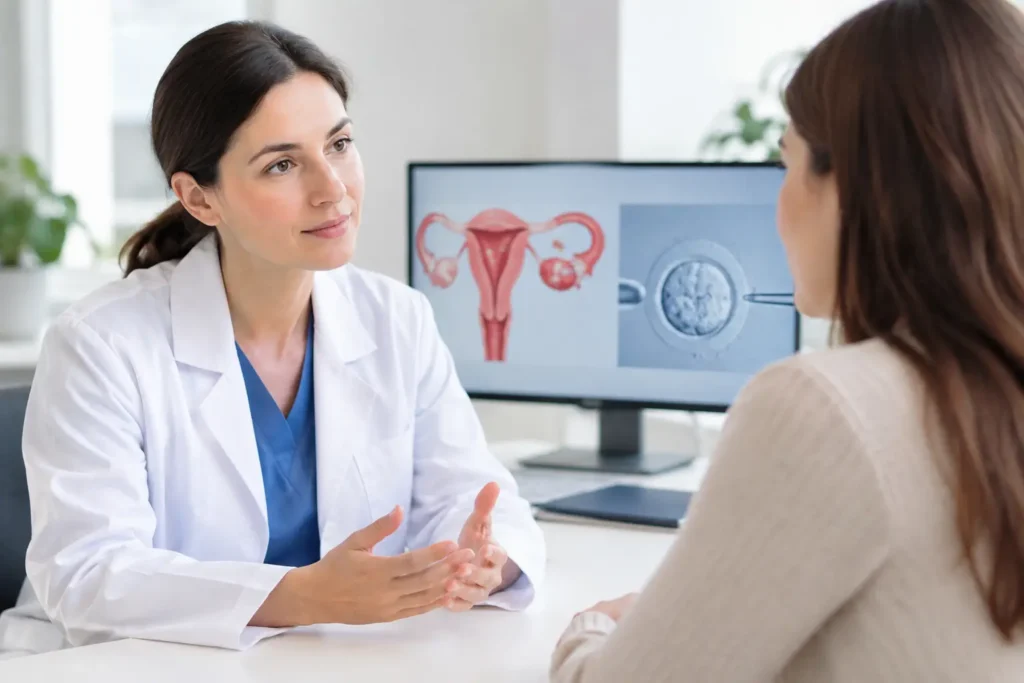
A fertility consultation is not simply about ordering tests. It is an opportunity to understand how endometriosis may be affecting your own path to pregnancy. Your specialist may review your symptoms, prior scans or surgery reports, menstrual history, previous pregnancies, and how long you have been trying to conceive.
Testing may include pelvic ultrasound, ovarian reserve testing, semen analysis for a male partner, and assessment of the fallopian tubes when appropriate. If you have already undergone IVF, reviewing the details of prior stimulation, egg maturity, fertilization, embryo development, and transfer outcomes can be especially informative.
The aim is to identify the factor most likely to benefit from action. For some couples, this may mean trying naturally or with timed treatment for a defined period. For others, intrauterine insemination may be considered when the tubes are open and other factors are favorable. IVF may be recommended sooner if there is tubal damage, significant endometriosis, low ovarian reserve, age-related urgency, or additional male-factor infertility.
Treatment choices depend on timing, symptoms, and goals
There is no single best treatment for endometriosis-related infertility. Hormonal medication can reduce pain and suppress endometriosis activity, but it prevents ovulation while it is being used, so it is not a way to conceive during that time. It may have a role before IVF or frozen embryo transfer for selected patients, particularly when there is more extensive disease, but the potential benefit should be weighed against the time involved and your reproductive timeline.
During IVF, your care team can tailor medication doses and monitoring to your ovarian reserve and prior response. The embryology laboratory plays an essential role in supporting fertilization and embryo culture. In certain situations, embryo freezing followed by a frozen embryo transfer may allow treatment to be planned separately from the stimulation cycle.
PGT-A may be discussed for some patients, such as those of advanced reproductive age or those with a history that raises concern for chromosomal abnormalities. It is not a universal answer to endometriosis and does not improve the underlying eggs. The decision should be based on expected benefits, limitations, cost, embryo numbers, and your priorities.
If pregnancy is not planned soon, fertility preservation may also be worth discussing. Egg freezing cannot stop endometriosis from progressing, and outcomes depend strongly on age at freezing and the number of mature eggs stored. Still, it may offer meaningful options for patients facing ovarian surgery, a declining reserve, or a need to delay parenthood.
Questions worth bringing to your consultation
You do not need to arrive with all the answers. It can help to ask whether your endometriosis appears to involve the ovaries or fallopian tubes, whether an endometrioma needs treatment before fertility care, and how your ovarian reserve may influence timing. If you have had prior IVF, ask what the cycle data suggests about egg maturity and embryo development rather than relying on a broad label of “poor egg quality.”
It is equally reasonable to discuss pain control, surgery, emotional support, and how treatment fits your family-building goals. Fertility care should account for your health and quality of life, not only a test result.
Endometriosis can add complexity to conception, but it does not define your potential to build a family. With specialist-led assessment and a plan that respects both medical evidence and your timeline, each next step can be made with greater clarity and hope.


